 Sassy
Sassy
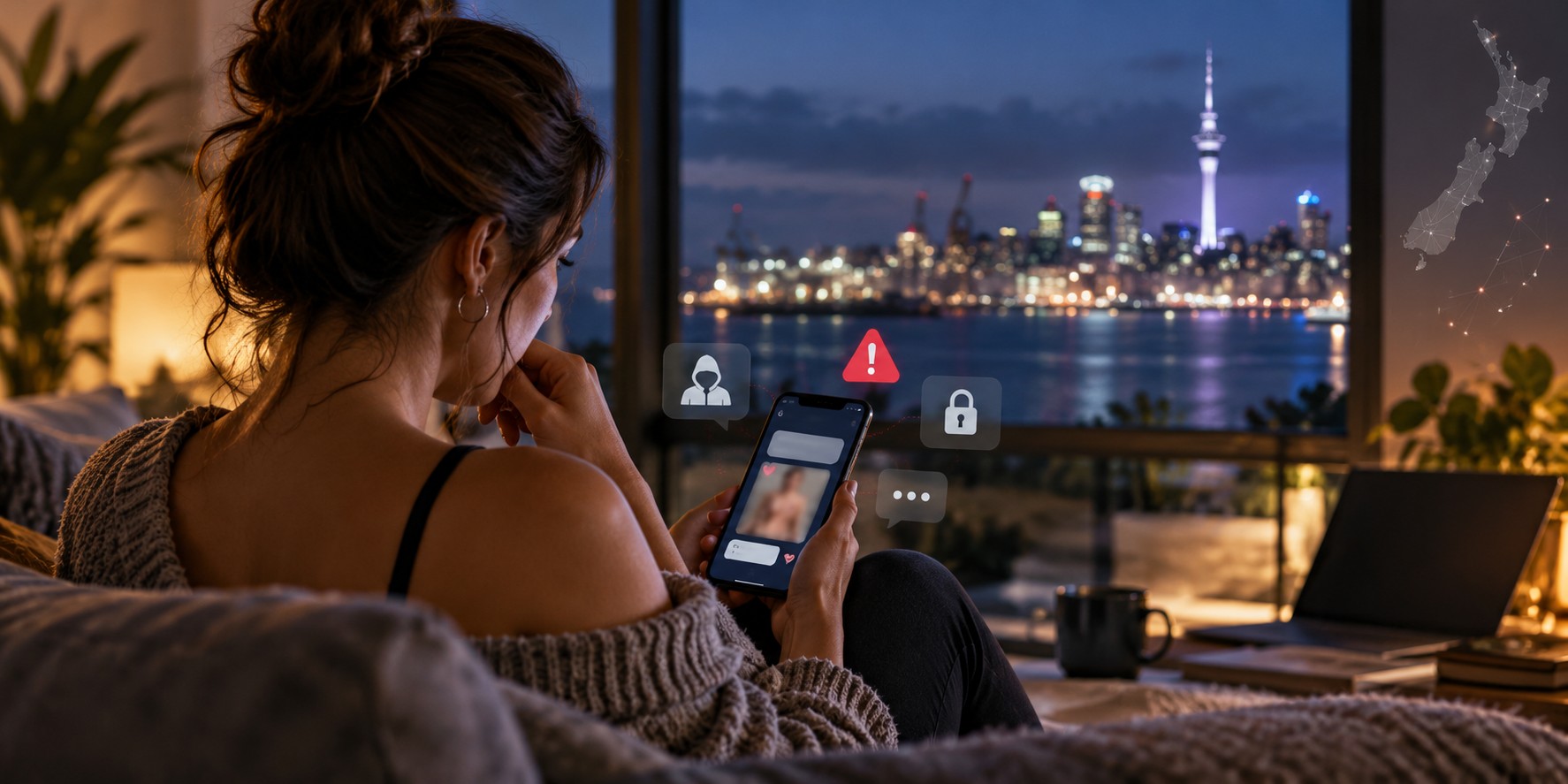
There is something particularly nasty about sextortion.
A scammer does not simply want your money. They want the panic that comes before it — that horrible little moment when you realise somebody may have a photo, video or private conversation you absolutely do not want appearing in your family group chat.
And in New Zealand, the problem is growing.
Netsafe says sextortion reports have increased 88% since 2019. In October 2026, it also announced new specialist support for people affected by sextortion, image-based abuse and other technology-facilitated harm.
For me, this deserves particular attention in the adult-services world. Private conversations, discretion, photos and one-to-one messaging are normal parts of many adult bookings. Unfortunately, those same things can also give scammers something to exploit.
What Is Sextortion?
Sextortion is blackmail involving intimate or sexually explicit material.
Someone may persuade you to send a nude photo or video and later threaten to share it unless you pay them, send more content or follow another demand.
The uncomfortable twist is that the image no longer even has to be real.
Netsafe specifically warns that sexually explicit material used for sextortion may be digitally faked.
That changes the privacy conversation completely.
A person who has never sent a nude photo in their life could still potentially have an ordinary social-media photograph manipulated into convincing sexual content.
How Sextortion Can Enter Adult-Service Conversations
Most adult bookings are simply two adults communicating about time, location, rates and boundaries.
That does not mean every person behind a profile is genuine.
A fake escort profile may start with a perfectly ordinary conversation before encouraging someone to move to WhatsApp, Telegram, Snapchat, or another private platform. From there, the questions can become more personal.
A selfie for “verification”.
Your full name.
An Instagram account.
An intimate picture.
Perhaps even identification.
Once enough information has been collected, the tone changes.
I think this is why privacy deserves to be treated as part of booking safety, rather than something people think about afterwards. Our article on the reality of camming in New Zealand looks at similar problems around anonymity, copied content and material escaping the audience it was originally intended for. Inside the Reality of Camming in New Zealand
Once something leaves your phone, control becomes much harder.
Red Flags I Would Never Ignore
Not every unusual message is a scam, but some behaviour should make you considerably less polite about hitting the block button.
Be cautious if somebody:
* demands intimate photos as proof of identity;
* urgently pushes you onto another messaging app;
* asks for unnecessary personal or workplace information;
* repeatedly invents new deposits, security fees or verification charges;
* requests gift cards or unusual payment methods;
* threatens to expose you to your partner, employer or family;
* suddenly produces screenshots of your social-media contacts; or
* claims police, an agency or some wonderfully dramatic criminal organisation is coming after you unless you pay.
Money scams already appear in real adult bookings. EscortLocate recently covered an Auckland case where women were shown convincing-looking payment evidence for transfers that had never actually arrived. The Auckland Escort Payment Scam That Fooled Three Women
Different trick, same useful lesson: something looking convincing on a screen does not make it genuine.
AI Has Made the Problem More Uncomfortable
This is the part I find most concerning.
Generative AI has made fake intimate images dramatically easier to create. A scammer may no longer need to persuade someone to send explicit content first.
A normal photograph can potentially become the raw material.
That means old advice, such as “just don't send nudes”, is no longer enough.
Protect ordinary photographs, too. Keep personal and professional identities separate where appropriate, review social media privacy settings, and think carefully before giving strangers enough information to link an adult profile to your everyday identity.
For providers, our broader guide to sex-work safety in New Zealand explores why screening, boundaries and personal security still matter even in a legal, decriminalised industry. Sex Work Safety in New Zealand
What Should You Do If Someone Is Sextorting You?
First: do not panic-pay.
New Zealand Police advises victims not to send more images, to save conversations and screenshots, to block the offending profile, to report the content to the relevant platform, and to report the incident through Police or Netsafe.
Paying does not guarantee deletion. It may simply prove that frightening you works.
Keep the evidence before blocking. If there is an immediate threat to somebody's safety, call 111. Non-emergency offending can be reported to the police through 105, and Netsafe also provides confidential help.
And please remember that embarrassment is exactly what the offender is relying on. Asking for help removes some of that power.
Safer Adult Connections Start With Better Boundaries
Escort platforms cannot remove every risk from conversations between strangers, and I would be suspicious of any website claiming otherwise.
What we can do is encourage better habits.
Read profiles carefully. Protect unnecessary personal information. Be wary of strange payment demands. Do not distribute another person's private images. Respect boundaries, and leave a conversation when something feels wrong.
New Zealand's decriminalised sex-work framework gives adult sex workers important rights around consent, safer working practices and refusing services; our guide to New Zealand sex-work laws and resources explains that wider framework. New Zealand Sex Work: Rights and Resources
Privacy should work both ways.
Adult services are supposed to involve consenting adults making informed choices — not somebody quietly collecting enough information to frighten the other person later.
That distinction matters more than ever.
Frequently Asked Questions
Can sextortion happen even if I never sent a nude photo?
Yes. Intimate material may be digitally manipulated or AI-generated from ordinary photographs. A scammer may also bluff about possessing material they do not actually have.
Should I pay someone who is threatening to release my intimate images?
Paying is not recommended. It does not guarantee that the material will be deleted and may lead to further demands. Save the evidence, stop engaging, block and report the offender, and contact Netsafe or the police.
How can I reduce the risk of escort scams or sextortion?
Avoid sharing unnecessary personal information or intimate verification photos; keep social and adult identities separate where practical; be cautious about moving immediately to private messaging platforms; and treat unexpected payment or verification demands as warning signs.